

If you were to check on the official NVIDIA store for an RTX 5080 right now, you’ll see that the card is no longer being listed. That is because, well, NVIDIA seems to have quietly removed it on purpose.
The removal of its second most powerful Blackwell GPU on the consumer market comes rather quickly and after the removal of the RTX 5090. In light of its removal, prices for all the available RTX 5080 cards in the US reportedly skyrocketed by more than 2.2x its original MSRP of US$999 (~RM4,054). The new price is roughly what we as Malaysians are paying for the card, anyways, and as we mentioned in our earlier report, there appears to have been a spike in the pricing for the GPU, with online stores on Lazada and Shopee now selling brand partner GPUs for more than RM10,000 a pop.
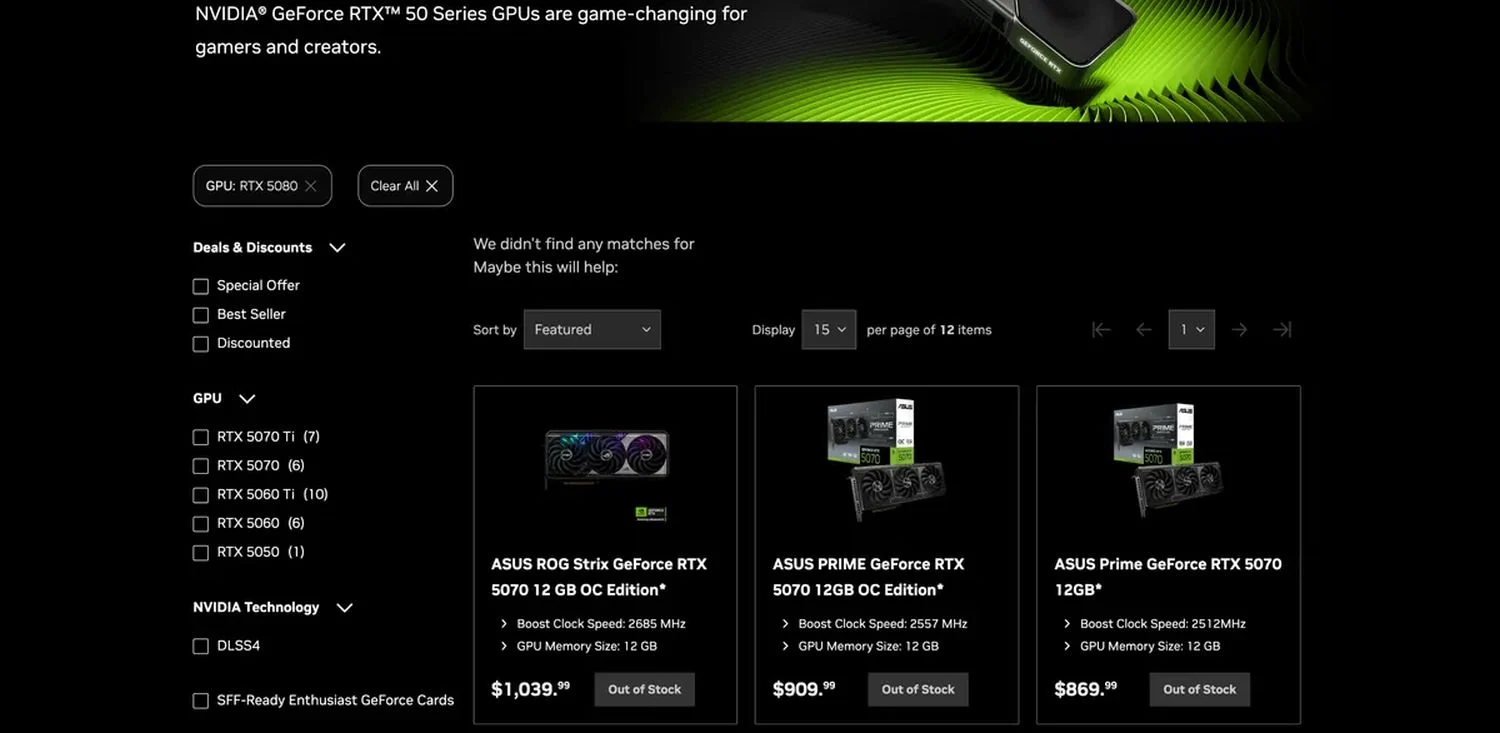
At this point, only the RTX 5070 Ti remains listed, as does the RTX 5070. It is possible that NVIDIA hasn’t removed these cards yet, in order to not rock this volatile market any further, although the removal of its two most powerful cards is clearly indicating a shift to something else.
Again, as previously reported, there is a rumour that NVIDIA is planning on releasing an RTX 5080 with 24GB GDDR7 memory. On top of that, it plans to discontinue the 16GB model, which is the current version of it. That rumour also stemmed from an earlier rumour, one that suggested that NVIDIA had put the production of its RTX 5090 on an indefinite hold, in order to shift its memory and GPU die inventory to the production of its RTX Pro Series.

NVIDIA responded to that rumour, stating that the RTX 5090 was still in production and had not been discontinued, although the current situation with both this card and the RTX 5080 disappearing from its store page is telling a different story.
The RTX 5080 launched in January of last year, the same time as the RTX 5090. You can check out our review for the card, as well as the review of the RTX 5090, if you’re still curious about their performance. The one takeaway from the argument was that, because the 5080 and RTX 5070 Ti shared the same amount of VRAM, as well as similar performance, it didn’t make any sense for one to pay the premium for the former.
(Source Tom’s Hardware)
