
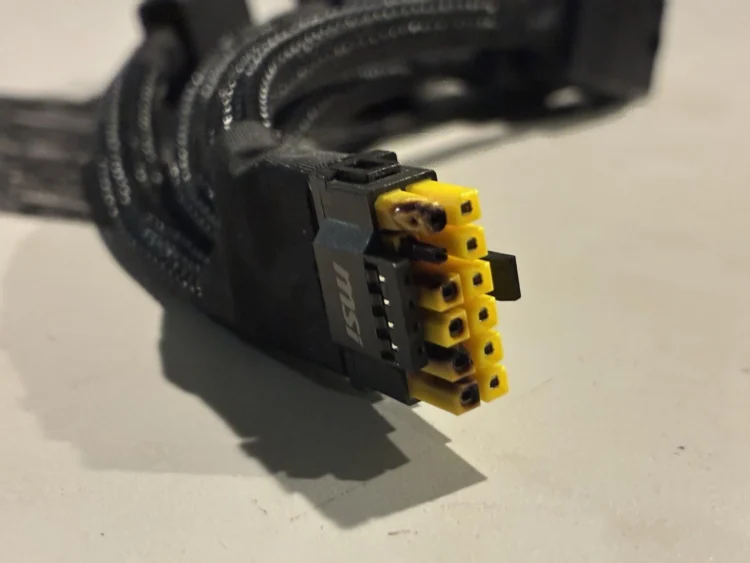
It’s barely been a week since NVIDIA launched DLSS 5 – albeit to a very “limited” list of titles – and the upscaler has supposedly already claimed its first victim in the form of a melted 12VHPWR connector of an RTX 5090. Yeap, it’s that kind of story.
The Cost Of Realism?

The story originates from the leakster site, Videocardz. It claims that one of its readers was testing out DLSS 5 Neural Rendering with their MSI RTX 5090 Gaming Trio OC, running NBA 2K27 (it’s the only game that runs the upscaler right now) when the burnout occurred.
The reader, who goes by the handle erek, was taking notes: Prior to the meltdown, they said that DLSS 5 caused the RTX 5090’s TGP to spike, going from 450W under load, to a sustained 600W. The MSI Gaming Trio OC itself is rated to run at a persistent 575W.

Erek kept receipts too, it seems. A GPU-Z screenshot they captured show the maximum board power draw hit 613.5W and even stayed there for a while. Mind you, this is board power and not power being observed coursing through the RTX 5090’s 12VHPWR connector alone. Therefore, it doesn’t necessarily mean that 600W was passing through the GPU connector.
Not long after that, our greatest fear became manifest. erek said that the card stopped working and the smell of burnt plastic permeated the area surrounding the card. Upon checking the card, they had difficulty removing the 12VHPWR from their RTX 5090, and when they finally pried it free, the plastic around the iconic yellow connector showed signs of melting.
Is DLSS 5 Really At Fault Here?

It’s still early days to say if NVIDIA’s Neural Rendering upscaler is to blame in this scenario. As it stands, melting 12VHPWR power connectors, especially those of the RTX 5090 variety, aren’t uncommon, even when precautions are taken to mitigate the issue.
Videocardz also points out that another RTX 5090 owner on another forum reported that they saw their card’s TGP spike from 435W to 520W after injecting DLSS 5 into Hitman 3, but the bottom line is that adding the upscaler to the mix may have contributed to the card’s burnout, but it may not have been the cause of it, and therefore this could be an isolated case.
(Source: Videocardz)
