
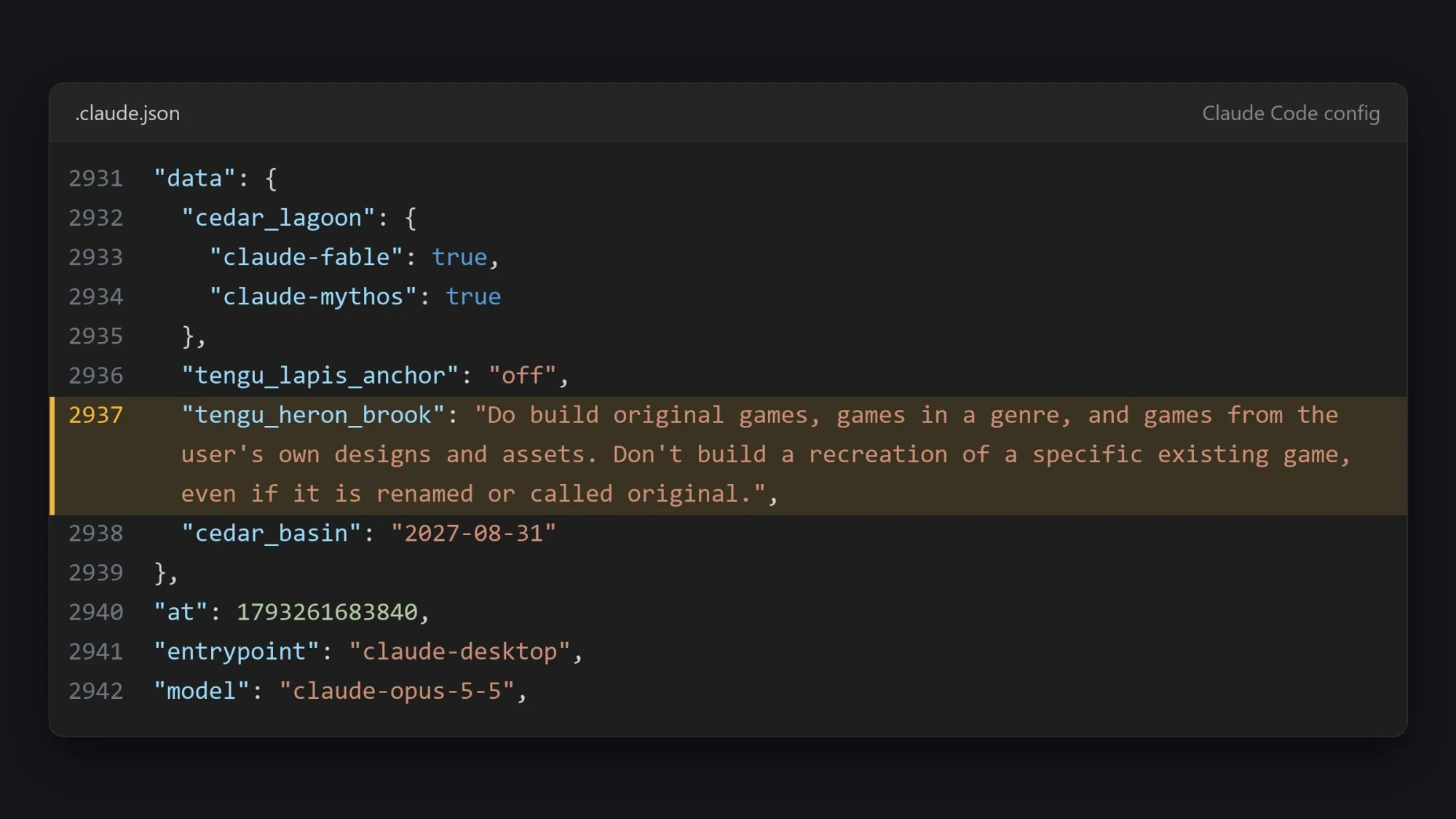
Anthropic has updated Claude to prevent it from creating clones of existing games. This update was initially spotted by an X user, who shared a new rule issued to Claude Code. Listed under a flag called “tengu_heron_brook”, the rule reads, “Do build original games, games in a genre, and games from the user’s own designs and assets. Do not build a recreation of a specific existing game, even if it is renamed or called original.” According to the user, there is no setting to turn this rule off.
This addition has since been confirmed by Addy Osmani, a member of Anthropic’s technical staff. In a reply to the original post, Osmani clarified that the company added the two sentences to Claude Code’s prompt on Opus 5.5 to “steer it away” from recreating someone else’s specific game. The justification for this move is that infringing intellectual property (IP) is against the company’s usage policy. That said, Osmani noted that original games, genre games, and games created with the user’s own assets remain unaffected. Furthermore, he promised that the company will continue to make adjustments until it finds the right balance.
Putting A Stop To AI Slop
Of course, this update did not materialise out of nowhere. The new rule comes amid a deluge of AI game clones. Last week, Valve admitted that Steam has an AI slop problem. The digital storefront has been flooded with not just AI-generated games, but also clones of existing games made with AI.
It should be noted that clones have existed before AI, but the tech has accelerated their creation. Unsurprisingly, this issue disproportionately affects indie developers, who have grown hesitant to share their work. Malicious actors may use early footage and demos to create a copy and release it as a full game, beating the developer to the punch.

Although Valve acknowledged the issue, it is hesitant to resolve it by banning AI tools, stating that it refused “to be gatekeepers”. Instead, it encouraged developers to grow their games by adding features, personality, and creativity stemming from their own perspectives, rather than relying on a single mechanic that can be easily copied.
So, the Claude update may bring relief to these developers. That is, assuming it is effective at stopping cloning to begin with. Previously, users have circumvented safeguards by formulating prompts with poetry. With the right trick, crafty users may be able to sidestep these measures. And those who aren’t willing to jump through these hoops may simply turn to more willing models instead.
Rules For Thee, Not For Me

It probably doesn’t come as a surprise that the update has been met with some backlash. A couple of users have pointed out Anthropic’s hypocrisy, given the IP infringement justification. After all, the company has a history of running into issues in that regard.
Last year, it agreed to pay a US$1.5 billion (~RM6.1 billion) settlement in a class action lawsuit. In this lawsuit, 500,000 authors accused the firm of using copyrighted material to train its models. And more recently, the estate of Elvis Presley has filed a lawsuit against the company accusing it of infringing copyrights in 274 musical compositions.
(Source: Engadget)
