
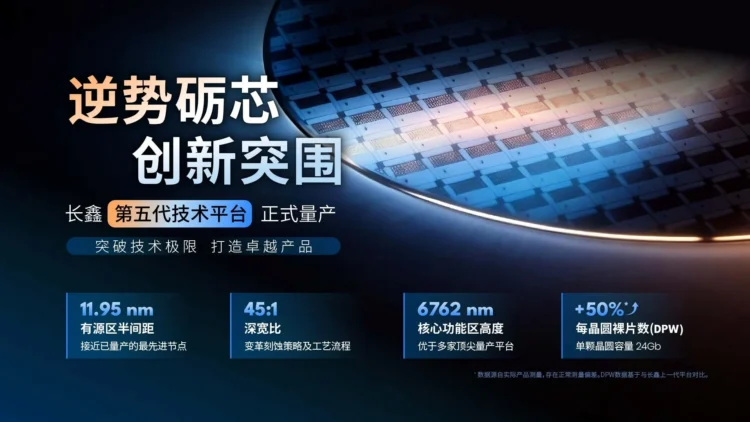
For years, Samsung, SK Hynix, and Micron have dominated the global memory chip market, supplying DRAM for everything from smartphones and PCs to servers. However, that dominance could face a stronger challenge from China, as the country’s leading DRAM maker, ChangXin Memory Technologies (CXMT), has announced that its fifth-generation technology platform has entered mass production.
According to CXMT, its new fifth-generation technology platform, dubbed G5, achieved a “quantum leap” in storage density, with gross die production per wafer increasing by at least 50% compared to its previous-generation platform. The company also said that the new platform delivers improved power efficiency at a lower cost.

South Korean memory chipmakers Samsung and SK Hynix are already using 10nm-class process technology for DRAM. CXMT, meanwhile, said its G5 platform has achieved an 11.95nm active-area half-pitch for its memory arrays through “quadruple patterning” technology, bringing it closer to what the company describes as “the world’s most advanced mass-production memory platforms”.
The company also unveiled two LPDDR5X products based on the G5 platform at the 2026 World Manufacturing Convention in Hefei. Both feature a 24-gigabit per-die capacity, representing a 50% increase over the previous generation of equivalent products, according to the company. CXMT said the products are already in mass production.
According to the South China Morning Post, CXMT said the new memory products are designed for “mid-to-high-end smartphones and portable consumer electronics”. The company also said it would “continue to advance technological iterations to meet global market demands” going forward.
The South China Morning Post report also notes that CXMT has been gaining traction among local smartphone manufacturers, with some of its high-end LPDDR5X DRAM chips already making their way into flagship Chinese handsets. One example is the Nubia NaviX Ultra, which went on sale last Wednesday and comes with ByteDance’s Doubao artificial intelligence assistant.
(Source: CXMT press release, South China Morning Post)
