
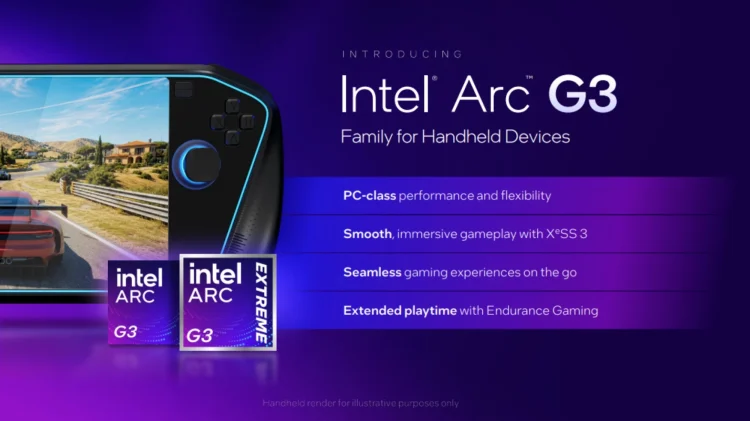
Earlier in the week, we reported on a rumour that Intel had a lower-tier Arc G3 — or Panther Lake, whichever pleases you at this point — processor that would ship out with fewer CPU and GPU cores. Now a new detail has emerged, suggesting that the alleged processor will have a configurable power envelope between 8W and 25W.
The rumour comes by way of Videocardz, who appears to have obtained it from sources either within or close to Intel. The new 8-25W TDP paints a clearer picture of what one could expect from the upcoming processor.
For context, the current Arc G3 Extreme and G3 have a peak TDP of 35W and 30W, respectively. In comparison, that’s between 5W and 10W for the alleged lower-tier processor.
As a quick recap, the original rumour of a lower-tier Arc G3 processor came by way of serial leakster Jaykihn. They originally said that the new processor would have a 4+0+4+4 configuration. To break that down, that’s four P-Cores, zero E-Cores, four Low Power (LP) E-Cores, and four Xe3 Cores. The number of Xe3 Cores is the one that matters, because the G3 Extreme and G3 have 12 and 10 Xe3 Cores, respectively.

Specs-wise, the Arc G3 Extreme has a CPU boost clock of 4.7GHz for its P-Cores, while the non-Extreme G3 is just 100MHz slower at 4.6GHz. The iGPUs are different as well, with the Extreme model running on the more powerful Arc B390, while the Arc B370 powered the non-Extreme G3. That said, it should be noted that the latter APU hasn’t actually been released; handhelds with the G3 Extreme have so far been paving the way.
There are undoubtedly a lot of speculation over the point and benefit of Intel releasing a version that is less of a performer than even the current G3. One point that seems consistent, though, is the price. Given the current price point for handhelds — the Arc G3 Extreme-powered MSI Claw EX 8 AI+ retails upwards of RM7,000 — it is quite possible that the existence of this processor may lead to a handheld that is less expensive, albeit at the cost of performance. But, as we said before, this also heavily depends on just how much more expensive memory and DRAM chips are going to be in the future.
(Source: Videocardz)
