
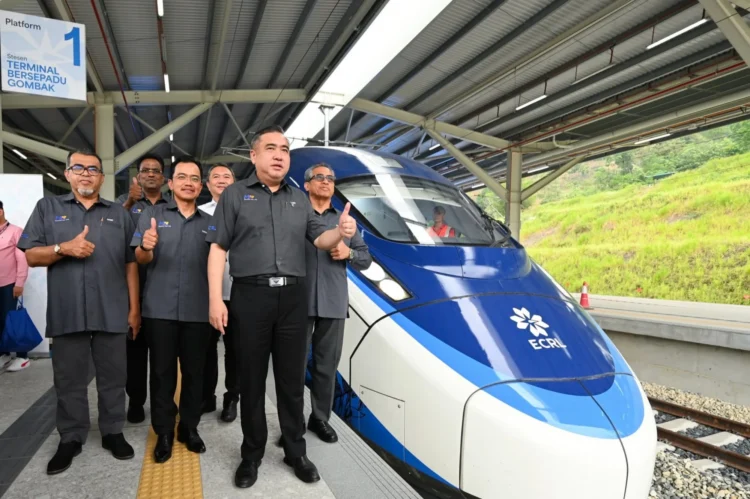
Transport Minister Anthony Loke has revealed that Phase 1 of the East Coast Rail Link (ECRL) project has attained 95.08% completion as of July this year. Although the service is scheduled to begin in January 2027, the minister is aiming to expedite the start of operations. As such, commercial operations could commence as soon as this December.
Of course, this does depend on a few factors. According to Loke, the ongoing testing and commissioning processes, including the System Integration Testing (SIT) and Fault-Free Run (FFR), must proceed smoothly without compromising on safety. He went on to reveal that the testing and certification processes typically take around two to three months, but the government is looking into ways to shorten that time.
Meanwhile, Phase 2 of the project is expected to be completed by the end of next year. Operations for this stretch, which will connect Gombak to Port Klang, should begin in January 2028.
FFR To Start In September

The ECRL project has passed a few notable milestones, including the commissioning of the Comprehensive Inspection Train (CIT). As the name suggests, this is a specialised train that will be used for the inspection and maintenance of the 665-kilometre network. Aside from that, the main power supply network for the rail line was recently completed with the electricity activation of all ten feeder stations.
Now, the ECRL project has moved towards the testing and commissioning phase. The SIT, which starts this month, will serve to test the integration of the electrical and signalling systems, as well as other related mechanisms. Then, in September, the FFR will begin. Of course, the FFR can only commence once all previous tests have been completed and approved. The first train set and E-Loco must each undergo FFR over a distance of 8,000km under the supervision of the Land Public Transport Agency (APAD).
Transporting Up To 10,000 Passengers Daily

Once operations begin, the ECRL should have the capacity to carry up to 10,000 passengers a day. Loke claimed that the project would have 10 train sets, with each set carrying between 300 and 425 passengers depending on configuration. So far, five train sets have reached Malaysia, with the rest expected to arrive in the coming months.
Each train can attain speeds of up to 160km/h and will feature facilities like a control room, conference room, prayer room, dining area, business class cabin, multimedia room, and washrooms. The service is expected to reduce travel time between the Gombak Integrated Terminal Station and KotaSAS Station to 1 hour 35 minutes via the express route. In comparison, the journey would take about three hours by road. Furthermore, the travel time from Gombak to Kota Bharu is estimated to be around four hours.
Stations Also Reaching Completion

Alongside the launch of the CIT, the designs of the main stations were also unveiled. Each station will incorporate local heritage, architecture, as well as cultural elements from Kelantan, Terengganu, Pahang and Selangor.
Furthermore, Loke confirmed that the Gombak station has reached 98.96% construction progress and should be completed by this September. This station will feature elevated platforms, passenger waiting areas, a Business Class Lounge, convenience stores, parking facilities, and covered walkways. It will also link the Kelana Jaya LRT Line to the 24-hour Gombak Integrated Terminal.
(Source: Bernama, New Straits Times)
