

When Valve raised the price of the Steam Deck significantly in May this year, it did two things: destroyed the handheld’s status as one of the more affordable devices of its kind on the market, and gave the gaming industry a signal of things to come. The spike in its price also unsurprisingly led to a massive drop in its demand.
According to Boiling Steam, sales of Steam Deck units fell by as much as 82% following the increase in its price. This was calculated by the site’s aggregate of Steam’s weekly revenue rankings, taken primarily from SteamDB data.
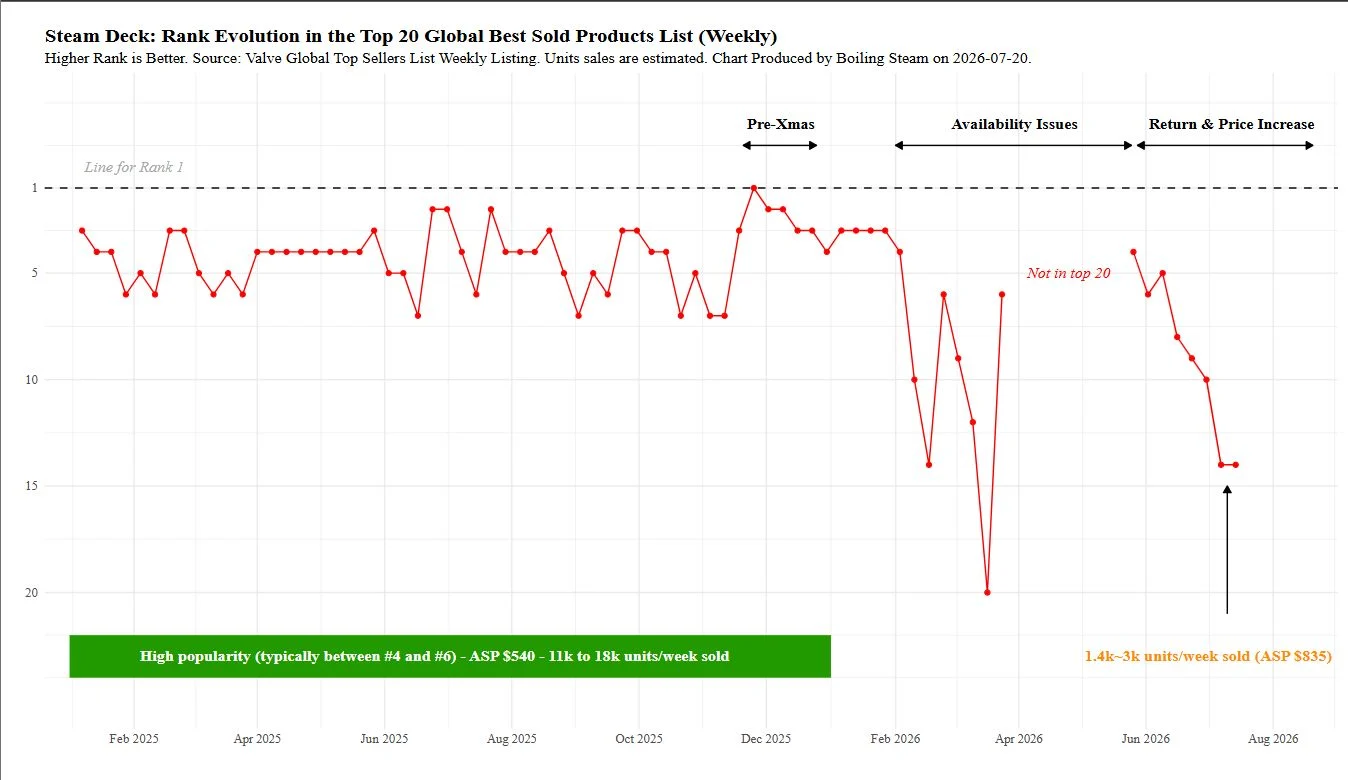
Between the time Valve raised the price and 2 June of this year, the handheld fell from being one of the top five most sold devices to 14th place. Then, on 14 July, popularity for the console fell by another two places to 16th.
The Steam Deck first launched in 2022, and retailed at a starting price of US$399 (~RM1,630) for the 256GB LCD model. In 2023, the company rolled out the Steam Deck OLED with two storage configurations: 512GB and 1TB. Both the 512GB and 1TB models saw their price tag increase by 46%; the 512GB model went from US$549 (~RM2,243) to US$789 (~RM3,224), and the 1TB model jumped from US$649 (~RM2,652) to US$949 (~RM3,878). The reason for the price hike is (you guessed it) due to the rising memory and storage prices.

To put those metrics in another way, it is estimated that Valve was selling between 11,000 and 18,000 Steam Deck units in 2025. As of July this year and post-price hike, the company is estimated to be selling between 1,400 and 3,000 units.
That said, we know that this technically matters little to us, considering that the Steam Deck, or any of Valve’s other products for that matter, are available in an official capacity in Malaysia anyway. On a related note, if you’re still in the market for a relatively affordable gaming handheld that is officially available in Malaysia, the Asus ROG Xbox Ally is currently your best bet, retailing for RM2,699.
(Source: Boiling Steam, TPU, SteamDB)
