
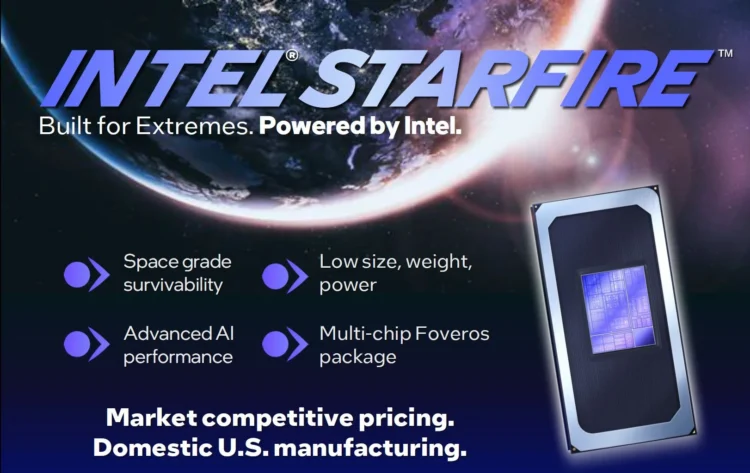
Intel came way out of left field recently with the introduction of Starfire, a processor designed for space. Yes, you read that right, space.
Specifically, Intel’s official fluff says that Starfire is designed for spacecraft and other systems operating in extreme environments. To that end, the CPU is designed with space-grade survivability and is low in size and weight.
As for its architecture, Starfire is based on Intel’s current 18A process node: the same die lithography as the one used with its Panther Lake, Wildcat Lake, and the Arc G3 Extreme, the latter being designed specifically for gaming handhelds.
In terms of variants, Starfire can be categorised into two SKUs: Low Power and Performance. Specs-wise, both are 8-core CPUs, divided equally into four P-Cores and four LP E-Cores, but they all have different clockspeeds.
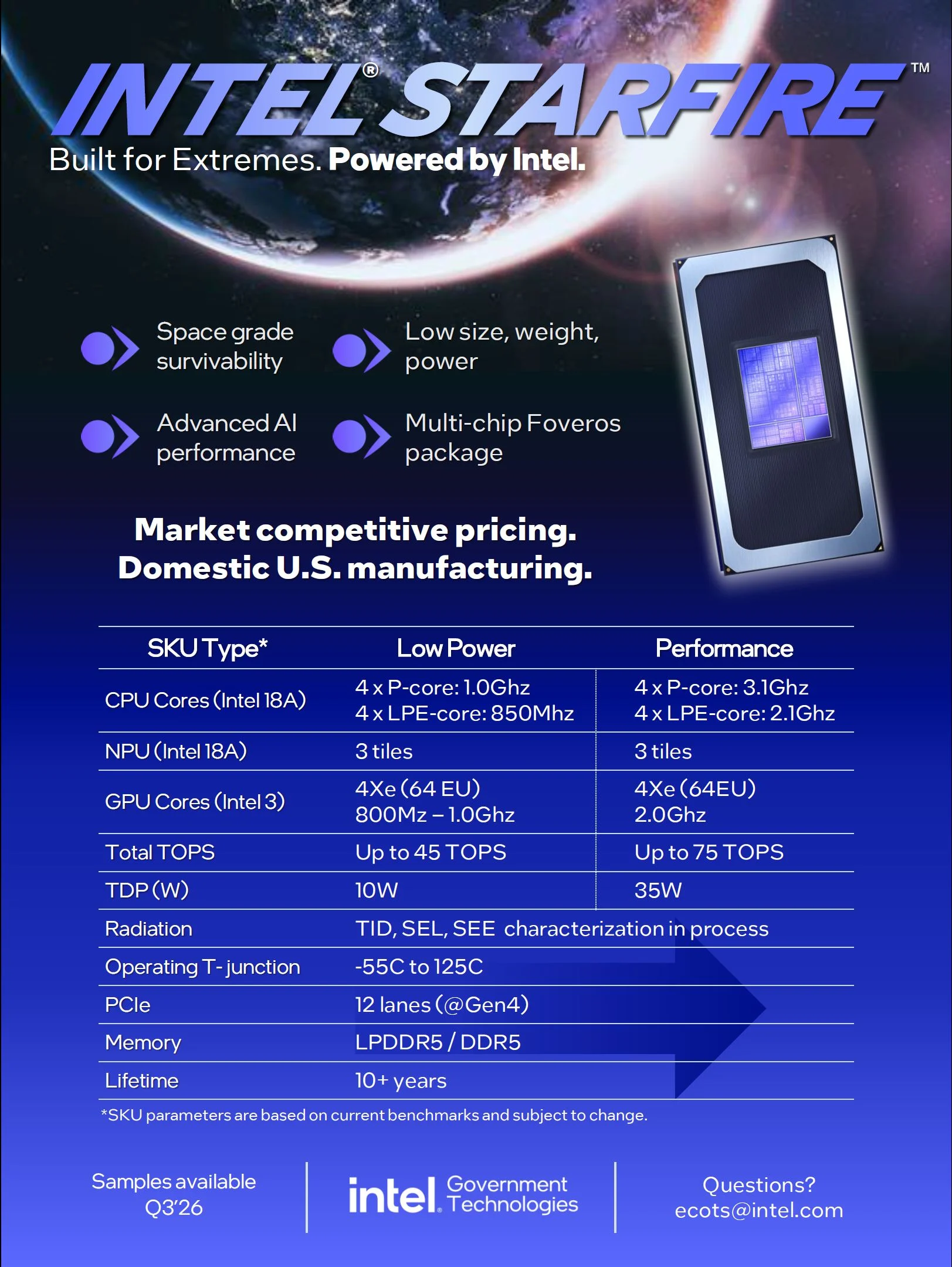
The P-Cores on the Low Power Starfire runs at 1GHz, while the LP E-Cores run at 850MHz. The P-cores for the Performance SKU run faster at 3.1GHz, while the LP E-Cores run at 2.1GHz. Both models have the same NPU, which comes with three tiles.
The Starfire models also share the same number of Xe cores at four units or 64 EU, but again, the Low Power option runs between 800MHz and 1GHz, while the Performance model runs at 2GHz.
Total TOPs on both options are different, with the Low Power running a total of 45 TOPs, while the Performance SKU has a 75 TOPs peak performance. Also, the former has a TDP of 10W, while the latter has a 35W TDP.
Starfire also supports LPDDR5 and DDR5 memory, plus 12 PCIe 4.0 lanes. What really sets this apart from the consumer segment is their operating junction temperature, between -55°C and 125°C, along with a planned product lifetime going beyond the 10 year mark.
And for an extra added sense of US patriotism (for Intel, anyway), Starfire will be manufactured entirely in the US.
(Source: Intel)
