

While AMD is expected to announce its next generation Zen 6 architecture next year – presumably at CES 2027 – some performance metrics of a 10-core Medusa Point APU have appeared on Geekbench. And from the looks of it, it’s looking promising.
The Zen 6 sample, codenamed AMD Plum-MDS1, scored 3,174 on the single-core test and 15,092 on the multi-core test. Once again, scores posted on the online repository aren’t reflective of the actual real-world performance that a processor is capable of, but they still do provide an idea of what one can expect.
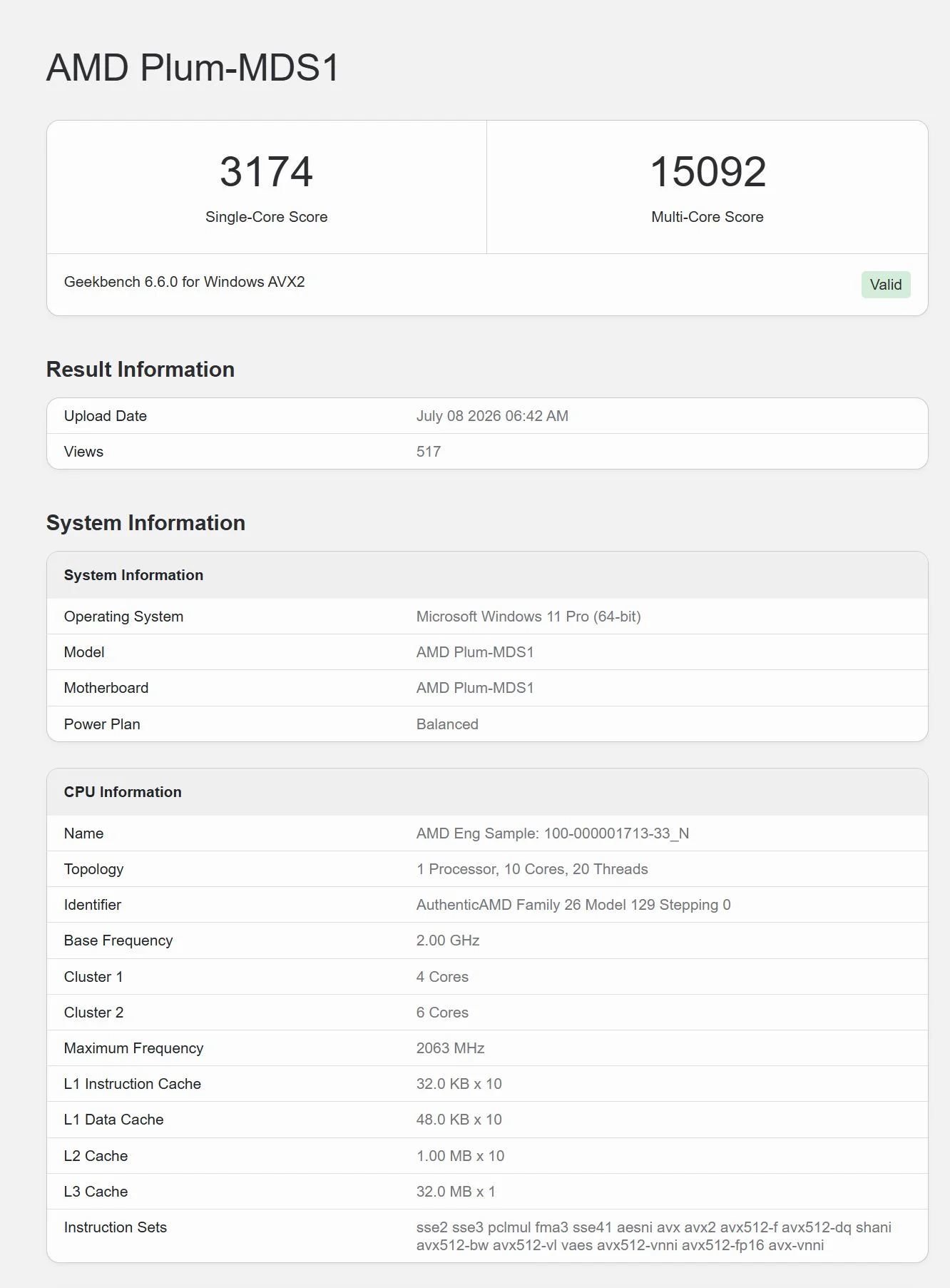
As mentioned, the Medusa Point APU is a 10-core processor, comprising 4-cores in one cluster and 6-cores in a second. Our guess is that the first cluster is Zen 6, while the second comprises the low-power Zen 6c cores.
As far as performance goes, the scores indicate a greater, if not significant, improvement over the Ryzen AI 9 HX 370 that launched all the way back in 2024, and over the Ryzen AI Max+ 395. Both APUs, by the by, we reviewed.
If we’re getting into specifics, the 10-core Medusa Point appears to be 22% more powerful in single-core performance against the HX 370, and 13% faster on average in multi-core performance. Against the Max+ 395, it beats it by over 400 points in single-core, but loses out in multi-core.
The only question at this point, then, is battery performance. As it stands, AMD’s current Ryzen AI 400 Series aren’t as power efficient, and Intel has far surpassed them with Lunar Lake prior and, more currently, with Panther Lake: our time with the dual-screen Asus Zenbook DUO 2026 certainly impressed us, exceeding our initial doubts about it.
(Source: Tom’s Hardware, Geekbench)
