
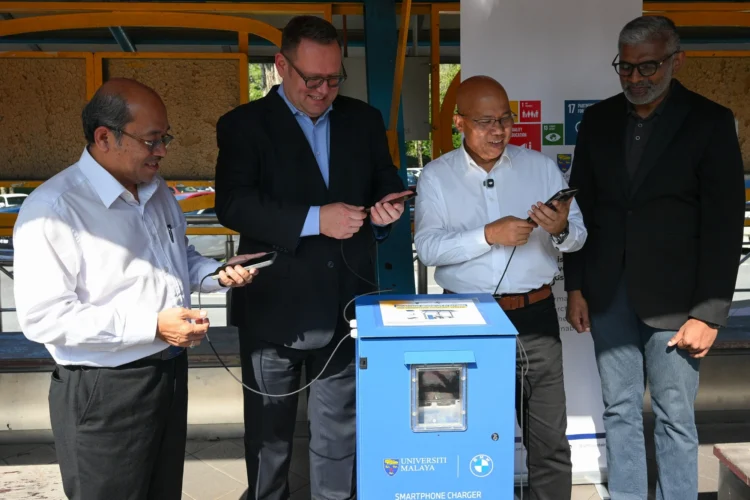
At the start of the year, BMW Group Malaysia announced that it was working with Universiti Malaya (UM) on research that would give aging batteries from the carmaker’s older EVs continued use. Part of this is letting these second-life batteries be used either for rural electrification or as an on-campus sustainable energy solution. Today, the two entities have announced the latter, with one solar-powered smartphone charging station placed at the UM Central bus stop that serves over 3,000 daily users.
Per the announcement, the charging station makes use specifically of lower-capacity battery packs, which BMW notes to be better suited to the lighter demands of device charging. Meanwhile, the higher-capacity packs are being prepared for deployment to Pos Sinderut, Kuala Lipis, Pahang for off-grid electrification for the Semai Orang Asli community. These will power a range of household appliances, from lighting and fans to refrigerators. But beyond the battery capacity sorting, and that the solar panels were “generously donated by a private individual and company”, not much else has been shared on that front.


Back to the phone charging station at the UM Central bus stop. BMW says that the station is powered by a 1.5 kWh system assembled from three battery modules that are about 10 years old. The charging station has three USB-C ports and a Lightning port for older Apple devices. Its maximum combined output is noted to be 200W, while the maximum output for a single port is locked to 100W. The station also has data loggers to record battery parameters and usage, with “a trained group of students” monitoring and maintaining the system.
BMW also said that the system is designed to remain operational for at least five years. That being said, the batteries involved are unlikely to have a third-life application with their current state of degradation. On the other hand, the batteries with higher charge retention used for rural electrification can be used here instead once they are done with their second life application. Or in other words, when their charge retention gets too low for off-grid electrification.
