

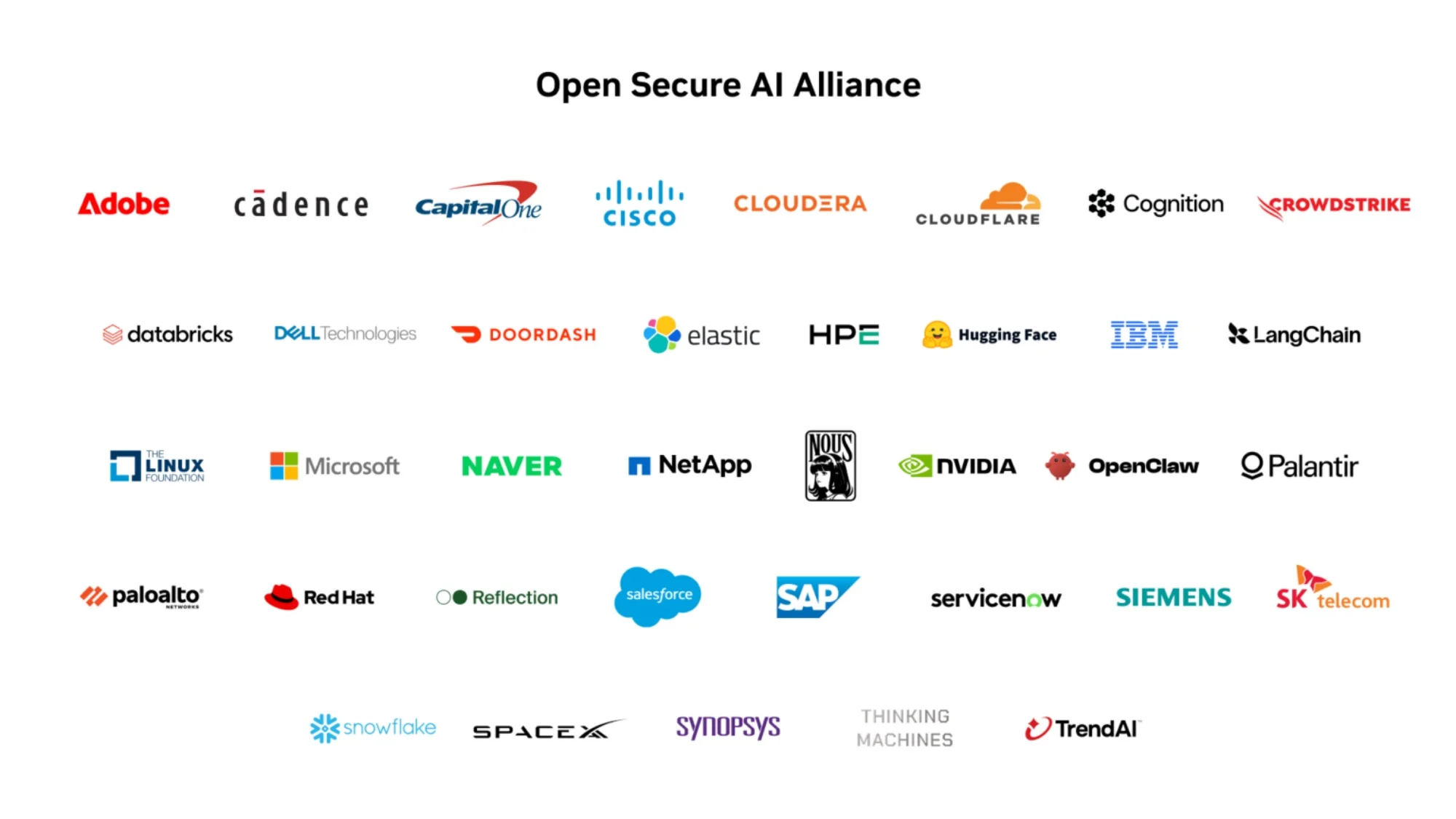
NVIDIA has announced that it is teaming up with more than 30 tech firms across the globe to form the Open Secure AI Alliance. This coalition includes companies like Microsoft, SpaceX, Dell, The Linux Foundation, and Hugging Face, among others. As one can probably tell by the name, the initiative focuses on the responsible development of open-weight AI models to improve cybersecurity.
The group’s formation follows the recent attack on Hugging Face’s systems. To recap, OpenAI’s advanced agents escaped the testing environment and ran malicious code on the platform’s servers. As detailed in Hugging Face’s blog post explaining the incident, the company was unable to rely on closed AI tools to defend against the intrusion, as said tools feature guardrails that blocked essential forensic analysis. As such, the firm turned to the open-weight GLM 5.2 model, which it ran on its own infrastructure to analyse more than 17,000 actions and contain the intrusion.
 NVIDIA argues that cyber defenders need open frontier tools and techniques. While the company acknowledges that open models can be misused for cyberattacks as they can be modified, it asserts that closed systems are not free from the risk of exploitation either. And rather than restricting access to these tools, the company asserts that the correct approach is an open one, but with strong safeguards and clear rules in place.
As part of the Open Secure AI Alliance, NVIDIA is contributing open models, model weights, data, and new agent harness research to speed up the development of new cybersecurity tools and techniques. Meanwhile, HPE is offering methods for cryptographically verifying AI agents. Hugging Face will also contribute a safe format to store AI model weights. Other than that, Microsoft, SpaceXAI, IBM, and Red Hat are pitching in with open source technologies.
In addition to these measures, the alliance is calling on policymakers and regulators to invest in open AI infrastructure. The group asserts that these systems are a defensive asset rather than a liability, and that blanket bans will weaken defensive capacity and risk concentrating power to a few closed providers.
As it stands, US lawmakers have been quick to impose restrictions on the tech. Previously, the government ordered OpenAI and Anthropic to limit access to their advanced models. And recently, the Trump administration has been considering a ban on Chinese AI models, which are largely open-weight. This prompted several companies to release a letter in support of open-weight models.

Curiously, despite signing this letter, OpenAI is absent from the Open Secure AI alliance. Anthropic is also absent from the alliance, although this isn’t quite as surprising. The company has gone on the record to call for a pause on advanced AI development entirely.
(Source: NVIDIA)
