

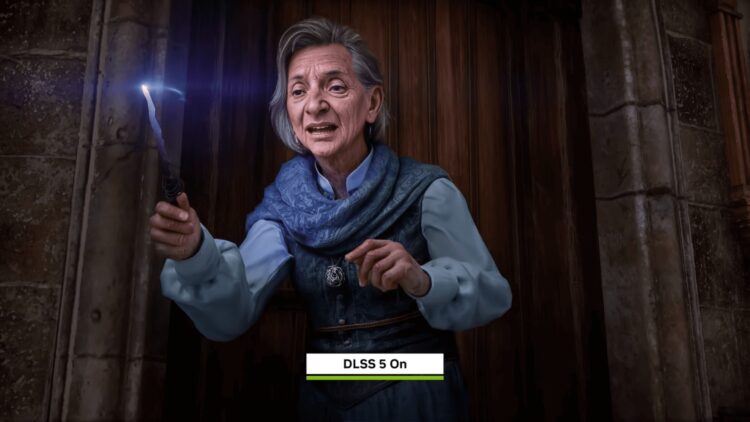
DLSS 5 has been announced and is set to roll out to games that support the feature later in this year, but as you’ve no doubt witnessed, the internet has been less than enthusiastic about it than NVIDIA expected. The company’s CEO, Jensen Huang, came out to defend it, but in a recent podcast, he seems to have softened his stance on it.
During a conversation on the Lex Fridmann podcast, talking about AI technology, Huang was asked about the hullabaloo surrounding DLSS 5, to which he said “I think their perspective makes sense,” and that he himself “doesn’t like AI Slop”. “You know, all of the AI-generated content increasingly looks similar and they’re all beautiful, so I’m empathetic towards what they’re thinking.”

Huang insists that DLSS 5 is just doing what it is trained to do: 3D conditioning, and that the artist is the one who dictates and determines the final outcome. “DLSS 5 is 3D conditioned, 3D Guided. It is conditioned by the artistry of the artist.” As he puts it another way, gamers have the impression that upcoming DLSS version will be doing post-processing on games that support it, which isn’t the case.
How DLSS Works
Deep Learning Super Sampling, or DLSS technology, has been around since the advent of the RTX 20 Series and the Turing architecture. The tool was released alongside the ray tracing capabilities of these cards, running a game’s visual fidelity from a lower resolution, upscaling it to the resolution of choice (usually, the native resolution of the display), and from there, padding it with all the little details and perhaps more that you’d get from running it at the native resolution.

The final result of this technology is basically a visual experience that looks just as good if the game were running at its native resolution, but with a higher frame rate, and more importantly, a workload reduction on the GPU in question. We actually wrote an explanation of the technology when Turing launched in 2018 and recommend that you give it a read.
In the meantime, we’ll have DLSS 4.5 rolling out to all PCs by the end of this month, although to be fair, some titles are already supporting it, including Battlefield 6.
(Source:
