



The field of artificial intelligence (AI) has come a long way, especially since the advent of different language models that are used to train systems and software to automate specific tasks and functions. But what if you want to take those actions to the next level? What if you want the whole process to function independently?
These days, that’s where Agentic AI comes in. Yeap, I know. You have questions, and luckily for you, we’re here to explain it – to be best of our ability – what it is and how they work. So, let’s start with the first and most obvious question…
What Is Agentic AI?
That’s a question that gets thrown around a lot. So, I’ll break it down in two parts: the short answer, and the longer, more complicated version of it.
Alright, here’s the simple response: Agentic AI, sometimes known as AI agents, are basically a group of…algorithms, for lack of a better word, and because there isn’t actually a standard definition for it. They’re fairly new and based on Generative AI (GenAI), and you can see this model’s work all over right now: Ghibli-fying pictures, generating text, videos, audio, and even software codes, and more importantly, pictures that, in its early stages, suffered from what the field calls “hallucinations” that manifested themselves in the form of undecipherable text or extra digits.
All through specific prompts, keyed into the language model that it is training.
Still with me? Good, cause here’s the slightly more detailed response to that.
Agentic AI takes things a step further. Unlike the traditional AI models, which requires a “human element” to give it is prompt consistently, Agentic AI requires a minimum amount of supervision, and once you’ve given it the necessary creative juices, the agents basically begin self-formulating, self-doubting, and rationalising by themselves.
I’m just going to borrow the explanation from IBM about Agentic AI to pad this explanation:
“Agentic AI builds on generative AI (gen AI) techniques by using large language models (LLMs) to function in dynamic environments. While generative models focus on creating content based on learned patterns, agentic AI extends this capability by applying generative outputs toward specific goals. A generative AI model like OpenAI’s ChatGPT might produce text, images or code, but an agentic AI system can use that generated content to complete complex tasks autonomously by calling external tools. Agents can, for example, not only tell you the best time to climb Mt. Everest given your work schedule, it can also book you a flight and a hotel.”
Like all AI models, though, Agentic AI won’t necessarily get it right the first time, and again, those who dabble in AI will understand that the reason for this. The answer these agents formulate actually depends on the information that they readily have access to. Simply put, the more information they have, the better informed they are, and in turn, the better the outcome and the more sophisticated their formulations.
Again, just going to borrow another explanation on how Agentic AI works from NVIDIA. To be clear, you don’t necessarily need NVIDIA-level hardware to train it, so long as the hardware is up-to-snuff and anything using a Neural Engine or Neural Processing Unit (NPU), which is just about anything these days, will do. If your system meets that criteria, then the pattern below is basically what follows:
“Agentic AI uses a four-step process for problem-solving:
-
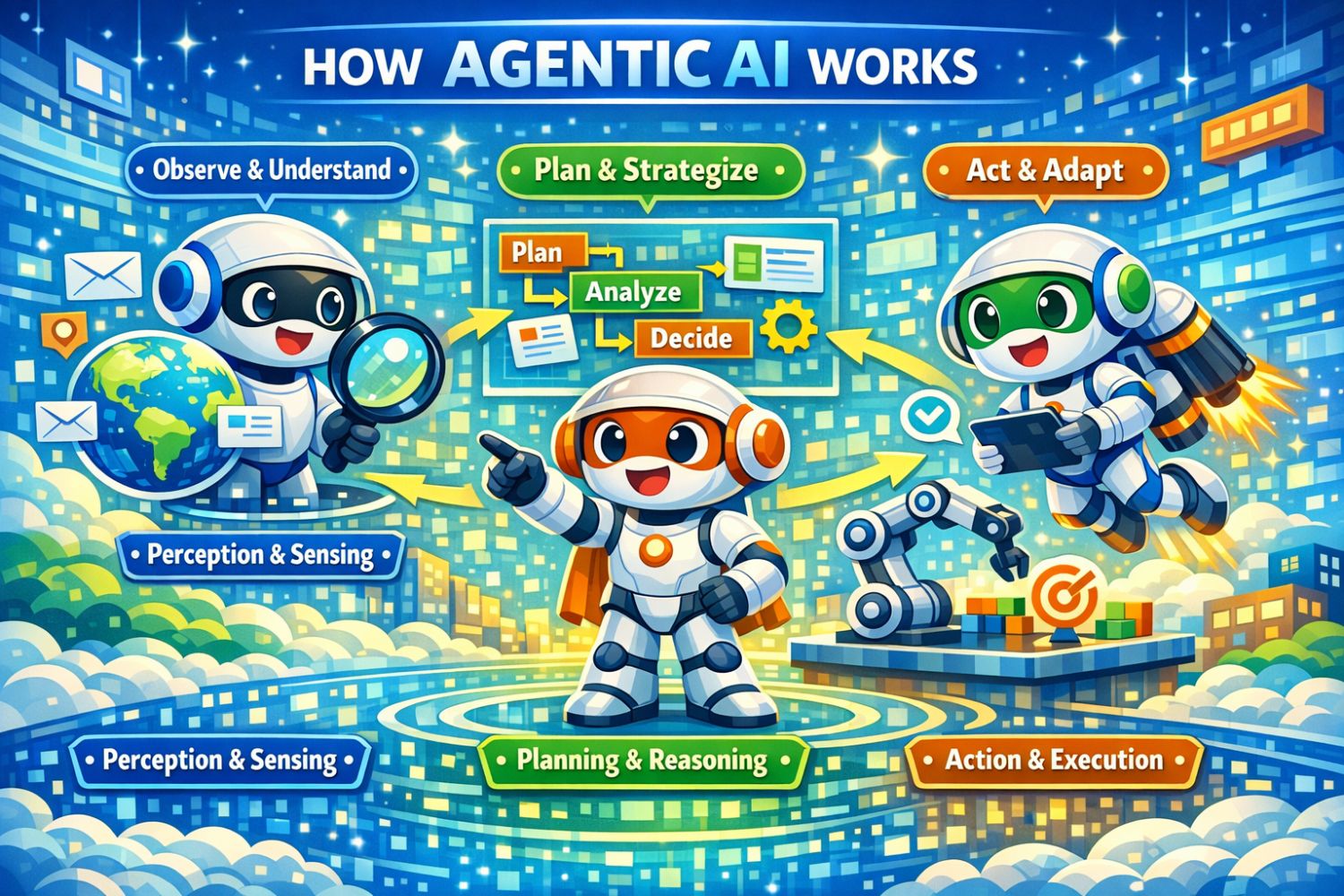
Perceive: AI agents gather and process data from various sources, such as sensors, databases and digital interfaces. This involves extracting meaningful features, recognizing objects or identifying relevant entities in the environment.
-
Reason: A large language model acts as the orchestrator, or reasoning engine, that understands tasks, generates solutions and coordinates specialized models for specific functions like content creation, visual processing or recommendation systems. This step uses techniques like retrieval-augmented generation (RAG) to access proprietary data sources and deliver accurate, relevant outputs.
-
Act: By integrating with external tools and software via application programming interfaces, agentic AI can quickly execute tasks based on the plans it has formulated. Guardrails can be built into AI agents to help ensure they execute tasks correctly. For example, a customer service AI agent may be able to process claims up to a certain amount, while claims above the amount would have to be approved by a human.
-
Learn: Agentic AI continuously improves through a feedback loop, or“data flywheel,” where the data generated from its interactions is fed into the system to enhance models. This ability to adapt and become more effective over time offers businesses a powerful tool for driving better decision-making and operational efficiency.”
And this is where the other term that has been associated with AI in all manners comes in: training. Just as we as humans train in specific tasks and actions to get better at them, so too does Agentic AI. These agents are able to adapt; they learn from experiences, take feedback, and even adjust their behaviour, so long as they have the relevant – not right, relevant – parameters and safety nets in place. We say relevant because, depending on the application, different players and industries have different use case scenarios for the tool. That segues us right into an important question.
Is Agentic AI Already In Use, And If So, Who’s Using It?

The most obvious and biggest industry player that has been crushing it since the start of the AI Boom is, beyond a shadow of a doubt, NVIDIA. Long before the publication of this article, the GPU brand has been ahead of the Agentic AI curve, selling AI startups and companies embracing the medium full-stack platforms, and Lord knows the drama surrounding the brand’s AI accelerators with the US and China.
That aside, and getting back on point: ever noticed how some customer service platforms you’ve interacted with tend to be more…relatable? Yeah, that’s most likely an AI agent.

More specifically, they’re basically “souped-up” chatbots. This isn’t anything new, by any stretch of the imagination, but Agentic AI basically takes it to the next level. Instead of drawing from a set, static list of responses, the agent trains itself to formulate a more…”human” response, but again, the training process takes time.
In the automotive industry, some brands are already applying Agentic AI in the development of their cars – ensuring the ADAS system is working; calculating the fastest route to your destination while taking into consideration the current status of traffic, all in real time.
Mannerisms, the different types of customers. the kind of questions they ask and the flow of said questions; Agentic AI can pick up on these outliers and, ultimately, be used to deliver that humanistic element.
Another use of Agentic AI? Cybersecurity. Deloitte, the multinational accounting firm, is one company that leverages the medium, both for and against the tide of AI-based threats and attacks. The long of short of this use is that by using and training AI agents to snuff out the threat, the agent could effectively identify the threat and, perhaps with more training, attack and destroy the threat at the source.

“Agentic AI systems don’t just analyse information — they reason and act on it. This introduces new security challenges: agents may access tools, generate outputs that trigger downstream effects or interact with sensitive data in real time. To ensure they behave safely and predictably, organizations need both pre-deployment testing and runtime controls.”
But the most common, if not obvious, application of Agentic AI on a consumer device? Smartphones like the recently launched Samsung Galaxy S26 Ultra. Through the Snapdragon 8 Elite Gen 5, users of the phone can make use of the Creative Studio function, creating an art piece from scratch or, in some cases, absolutely nothing. And yes, Galaxy AI is still a major factor, with Samsung having boosted its function in a new and improved Now Brief and Circle to Search With Google.
