
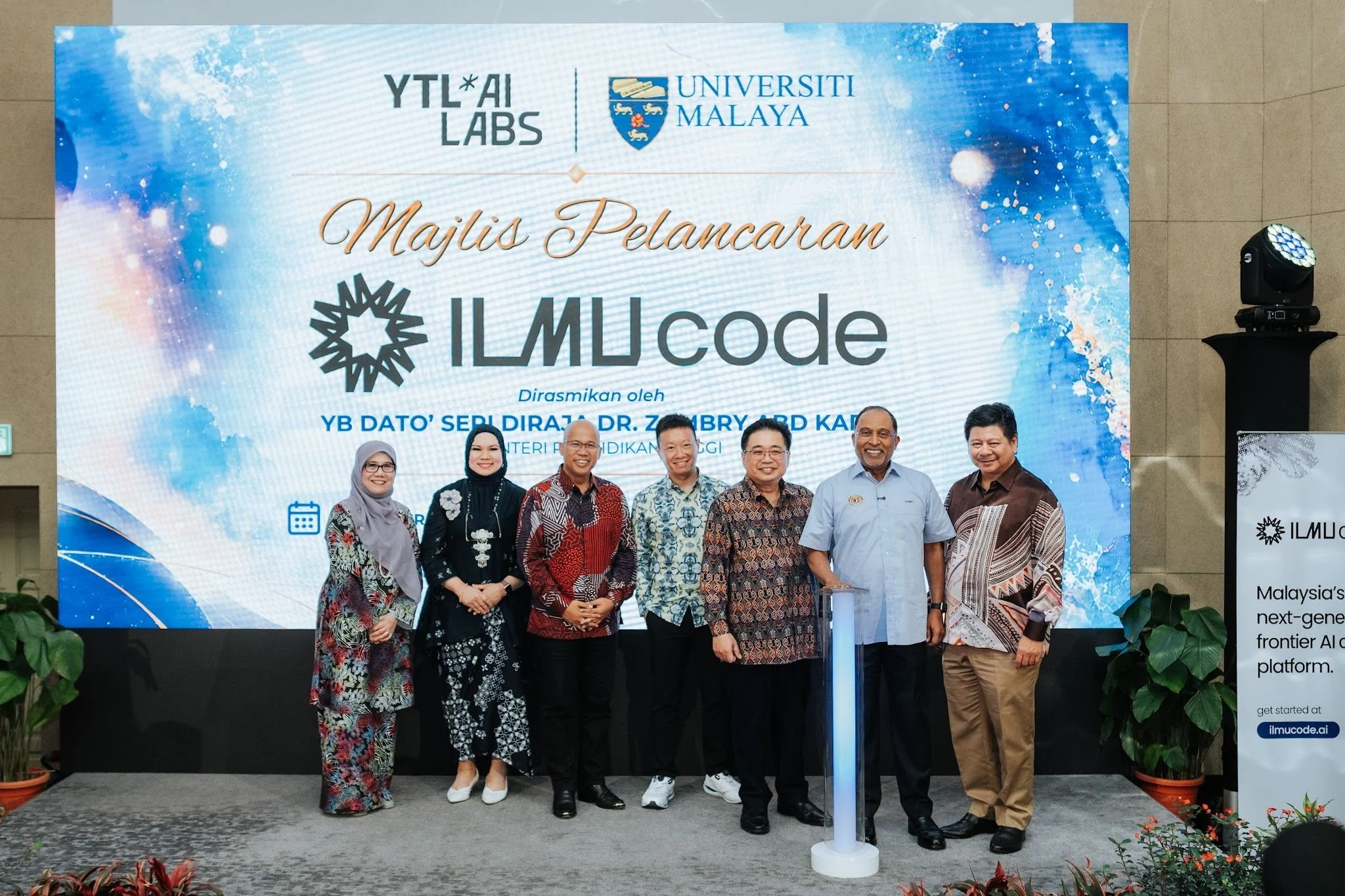
YTL AI Labs recently launched ILMUCode, its new AI coding platform. The new, next-frontier coding platform is designed and built to, as per the company’s statement, provide coders and developers with access to frontier-level coding capabilities through sovereign infrastructure, but at a fraction of the cost needed.
ILMUCode will combine Agentic AI with the company’s own language model, ILMU-GLM-5.3, both of which are built in partnership with Z.ai. “Through ILMUCode, developers, students and aspiring builders can work across the software development process- understanding complex codebases, writing and modifying code, troubleshooting problems, and turning ideas into working software faster. The performance of ILMUCode ranks among the world’s leading coding models on coding benchmarks such as Terminal-Bench 2.1 and DeepSWE.”

ILMUCode has been set up at Universiti Malaya and will be deployed in the next semester, where the university claims it will be used by 800 first-year students from the Faculty of Computer Science and Information Technology. Each student will receive RM100 in credit per month for three months, which they can then use to build and develop their own coding via the platform.
At its core is YTL AI Labs’ multimodal model, which it claims tops the MalayMMLU benchmark for Bahasa Melayu. This includes speech recognition, text-to-speech models, and embedding models, to name a few.
ILMUCode is just the latest addition to the YTL AI Labs portfolio of its ILMU-themed AI platforms. Earlier this year, the company launched its ILMU Claw Agentic AI Platform, which itself was made in collaboration with the GPU powerhouse and tech titan, NVIDIA. The system is powered by the ILMU-Nemo-Nano model, which is believed to be based on NVIDIA’s own Nemotron 3 Super MoE model.
In September, its partnership with NVIDIA went deeper with the launch of Nemotron-Personas-Malaysia, an open dataset containing 1.35 million synthetic personas, designed to help build AI models that were more in line and attuned to Malaysia’s diverse population, deriving details pulled from the country’s demographics and labour statistics.
