
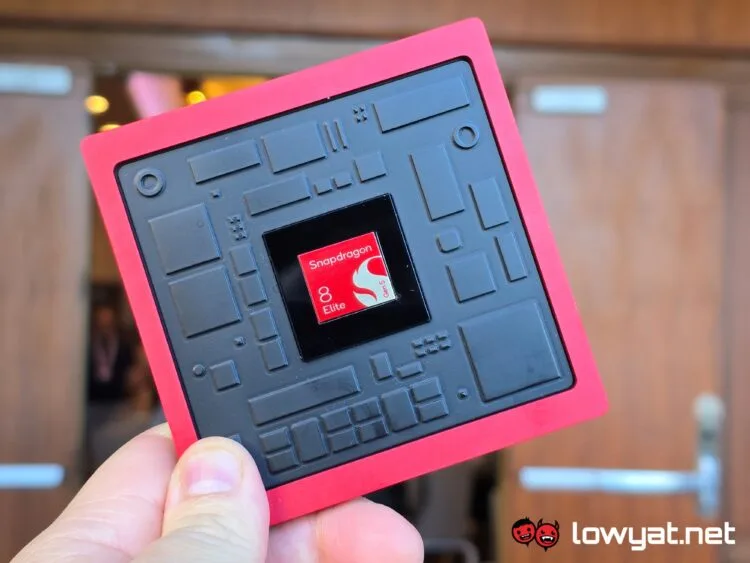
News portal Notebookcheck claims to have gotten first-hand information regarding Qualcomm’s next-generation Snapdragon 8 Elite Gen 6 chipset. Not only that, but the site also claims to have gotten the measurements and die size of said chipset.
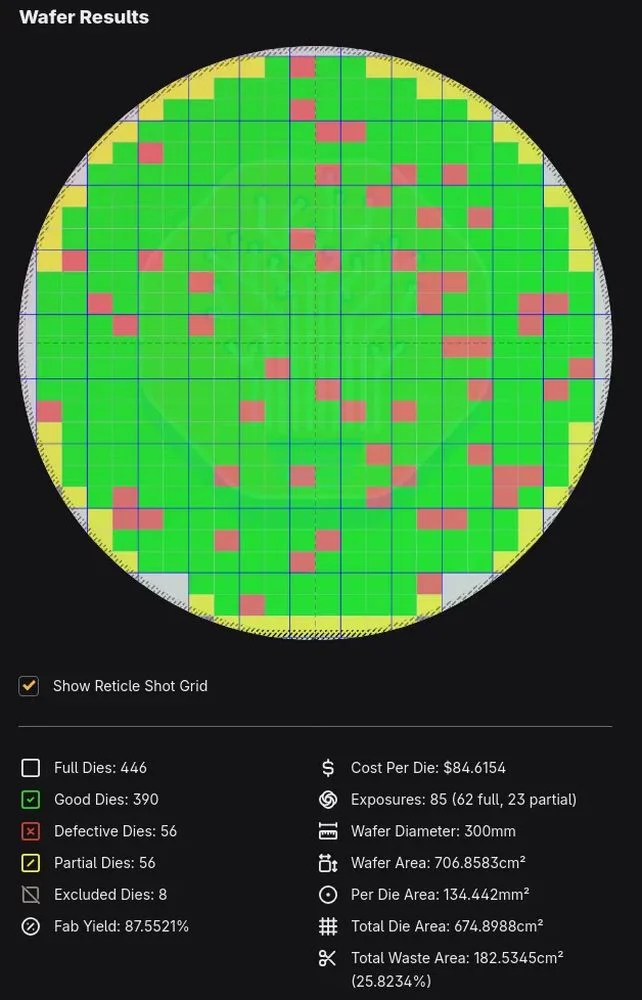
Supposedly, the die size of the alleged Snapdragon 8 Elite Gen 6 measures 21.2 x 14mm, putting the die area at around 134mm2. That’s actually larger than the current 8 Elite Gen 5 chipset, which has a die area of 126.2mm2. And while it is smaller than the MediaTek Dimensity 9500 SoC’s 140 mm2 die, it raises the question of how the next-generation chipset will be larger.
Notebookcheck says that the Snapdragon 8 Elite Gen 6 will be built around TSMC’s N2P process, an enhanced 2nm node, marking the company’s first move past the N3P process used in the development of the 8 Elite Gen 5 chipset. Additional details include a 2+3+3 Oryon Core configuration. That is two prime cores, three Performance cores, and three Efficiency Cores. While the exact clockspeeds of the processor is still unknown, online rumours put it at around 4.8GHz. The onboard GPU will reportedly be an Adreno 850, supporting currently existing APIs, including OpenGL ES up to 3.2, OpenCL 3.0 FP, EGL 1.5m, and Vulkan 1.4.
What sets the Snapdragon 8 Elite Gen 6 apart is the reported inclusion of two new dedicated Matrix ALU blocks. Through these blocks, Qualcomm is underpinning a new feature called AI Frame Fusion, which is the company’s own take on AI-based upscaling technology. Supposedly, this technology will operate in two modes. The first is a super resolution mode that uses motion vectors, a depth buffer, a low-resolution color buffer, and the previously rendered frame to upscale the output to 1080p or 1440p. The second is a frame generation mode that uses motion-vector and optical-flow reprojection across the current and previous frames to interpolate an entirely new frame between them, with the aim of boosting perceived frame rates without a proportional rise in power draw.

Other details include a new X106 modem for the chipset, along with wireless chips that will support the unreleased Wi-Fi 8 and up to Bluetooth 8.0, although this depends on the tier of the chips.
At the time of writing, no launch date has been given, but it is likely that we’ll hear more on the matter at the annual Qualcomm Summit in Hawaii.
(Source: Notebookcheck)
